
Federal Bureau of Prisons Releases
The Federal Bureau of Prisons, or BOP, is the correct federal source for people who entered its custody. For a Calhoun County resident or case connection, county geography does not create a local federal-prison roster. A sentenced person may be placed at an institution anywhere in the federal system. The BOP Locator follows that federal record rather than a West Virginia county. Its released-person coverage extends to federal incarceration from 1982 forward and to people released after 1982.
A BOP release means BOP custody ended on the date shown. It does not prove that federal supervised release ended, that another agency did not assume custody, or that the person returned to Calhoun County. Supervised release is a court-ordered period in the community after prison. Another warrant or immigration action can also affect the next destination. Name the custodian and event: release from BOP custody is the supported finding.
Search Federal Prison Release Records
The official BOP Inmate Locator accepts either a federal identifier or a name search. Identifier options include the BOP register number and DCDC, FBI, or INS number. A number is often more precise than a name. The name route accepts first and last name, with age, race, and sex available to narrow results. Compare every displayed identity field before treating a row as a match.
- Choose the number search when a BOP, DCDC, FBI, or INS identifier is known.
- Otherwise enter the full name and use the optional identity fields to narrow similar results.
- Match the name, register number, age, race, and sex rather than relying on one field.
- Read the Release Date beside Location. Decide whether the date is past or future.
- Confirm supervision or another custody system separately when the next legal status matters.
The manifest capture of the official federal inmate search shows the locator used for this route.
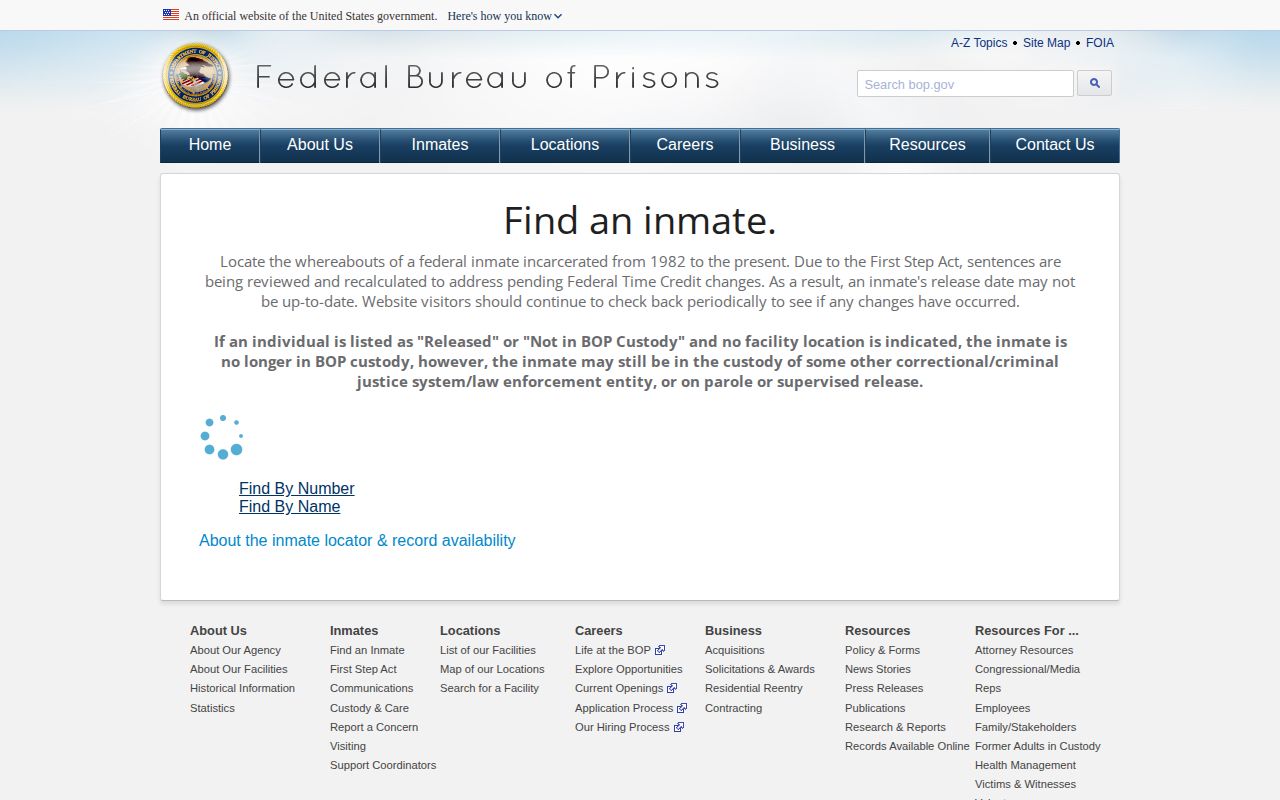
The screen is the entry point for sentenced federal custody and retained released-person results. It is not the West Virginia jail or prison interface.
Note: Keep the register number with any saved result because names and personal details alone can produce an uncertain match.
Federal Prison Release Result Fields
The locator returns a compact result. Each field has a limited purpose. The Release Date must be read with Location, and the whole row must be identity-matched. A listed person is not necessarily someone convicted in a federal criminal case. BOP states that its population records can also include a pretrial detainee, material witness, civil-contempt detainee, or person whose charges were dismissed. Presence in the locator alone is not proof of conviction.
| BOP field | What it shows |
|---|---|
| Name | The recorded identity, which must be compared with other fields. |
| Register number | The durable BOP identifier for the matching federal record. |
| Age, race, and sex | Identity details used to distinguish people with similar names. |
| Release Date | A past release from BOP custody or a future projected date, depending on timing. |
| Location | The current BOP facility when one is reported; no location with a past date supports released status. |
The locator does not display the full judgment, the terms of supervision, or another agency’s hold. Those questions belong to the federal court or the receiving custodian. A BOP record also does not answer a CRJCF regional-jail question merely because the person has a Calhoun link.
Read Federal Prison Release Dates
BOP provides a direct rule for a completed release. When the Release Date is in the past and no facility location appears, the person was released on that date and is no longer in BOP custody. That paired reading is stronger than seeing the word “released” without context. Preserve both the date and the blank or absent location when documenting the result.
The BOP explanation of federal inmate records supplies the official interpretation. It also sets the historical scope and explains why locator records may contain people held under several legal bases.
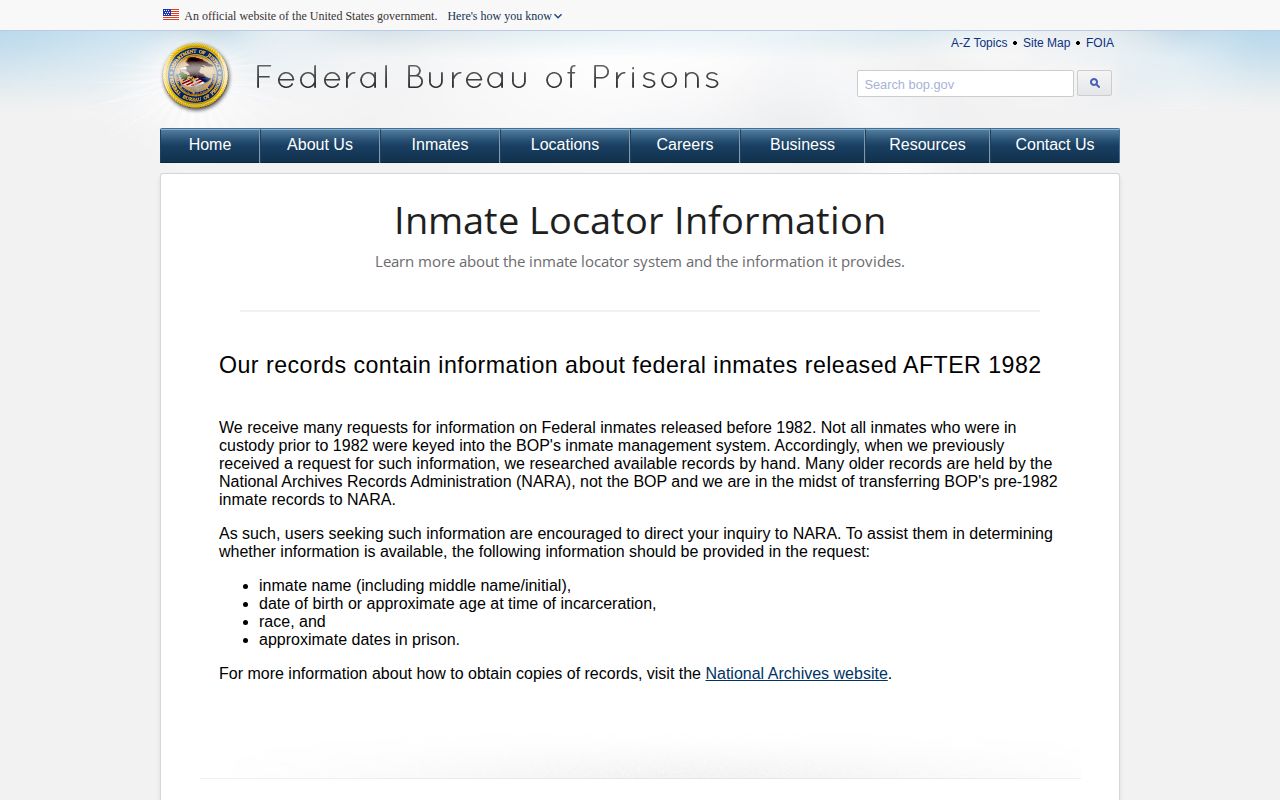
The official explanation connects a past date and no location to release from BOP custody. It does not describe the person’s later residence or supervision.
A future date has different meaning. It is projected and can change, including after credit recalculation. Do not report it as an actual release. Compare it again near the expected date, then look for a past date and no location after the event. The federal court docket can resolve the sentence and supervised-release terms, but the BOP record remains the public custody indicator.
Note: Capture both Release Date and Location because either field alone can produce an incomplete reading of federal custody status.
Federal Prison Custody Boundaries
Federal custody has stages. The U.S. Marshals Service manages federal pretrial prisoners and can place them in contract facilities. Such a person may never become a sentenced BOP inmate. Some pretrial or non-sentence categories can still appear in BOP records, so the court docket is needed to identify the legal basis. A federal district-court detention or release order answers a different question from the BOP custody row.
| Situation | Correct release route |
|---|---|
| Federal pretrial custody | Federal district-court order plus USMS custody records. |
| Sentenced BOP custody | BOP Locator and, when needed, the BOP record. |
| Past BOP release | Past Release Date with no location, then court review for supervision. |
| ICE custody after BOP | ICE locator and ICE records, not the BOP row alone. |
| West Virginia regional jail | WVDCR jail search, VINE, court order, and DCR release transaction. |
The separate Federal Pretrial Custody route applies when USMS, rather than sentenced BOP custody, controls the person. Switching systems based on the actual custodian prevents a no-result from being mistaken for release.
After Federal Prison Release
Release from confinement and discharge from all legal obligations are not the same. A federal judgment can impose supervised release after prison. U.S. Probation and the federal court govern that stage, not the BOP locator. The BOP result does not state that supervision ended. A later court order may modify or terminate supervision, and the district-court docket is the proper place to trace that legal action.
Another custodian can also take control at the end of BOP custody. An ICE action or other warrant can prevent a return to the community even when BOP correctly reports release. The locator says nothing conclusive about state custody, ICE custody, or a private residential destination. Follow the receiving agency when one is documented. Do not treat the lack of a BOP location as proof of where the person went.
- Release from BOP
- The Bureau of Prisons ended its custody on the date shown.
- Supervised release
- A court-ordered community phase following prison, administered through the federal system.
- Final discharge
- The end of the relevant legal obligation, which requires more than the BOP custody row.
- Receiving custodian
- Another agency that assumes control after the BOP episode ends.
Note: A BOP release result should never be expanded into a claim about residence, supervision completion, or freedom from another hold.
Older Federal Prison Release Records
The public locator’s useful historical boundary is 1982. For federal incarceration before that point, BOP directs researchers toward the National Archives. Supply the person’s name, birth date or approximate age, race, and approximate prison dates. Those facts help archival staff identify the correct record. A modern no-result does not establish that older federal custody never occurred.
The archive route is record retrieval, not a live custody check. It may establish the institution and period of confinement, while the old judgment or docket supplies the legal basis. Avoid forcing an older case into fields designed for the current locator. Preserve the source and record date because historic federal data answers a past event, not present status.
Federal Prison Records Route
No Calhoun County BOP facility address or local federal prison contact is supported by the research, so none should be invented. The correct public contact feature is the national online route. Use the BOP Locator for the custody result and the BOP records explanation for its meaning. For older material, follow the National Archives route described by BOP. For a federal judgment or supervision question, use the federal district-court docket and the proper federal record custodian.
Federal Bureau of Prisons Release Lookup
Current and released records: 1982 to present
Search inputs: federal number or name with optional identity fields
Official route: BOP Inmate Locator
Record interpretation: About Federal Inmate Records
Ask for an existing record, not a conclusion the agency would have to create. Identify the person with the register number and a narrow time period. State whether the requested fact is release from BOP custody, the judgment, supervision, or transfer to another agency. Routing the question to its record owner is more reliable than sending the same broad inquiry to Calhoun County, WVDCR, USMS, and BOP.
The Calhoun County released inmate lookup separates the local, state, and federal paths when the custodian is still uncertain.